Kids Makeup Palette Development Guide for Buyers
Table of Contents
A kids makeup palette is a product system built inside a limited space. The case shape attracts attention, but the internal architecture determines whether the shades, pans, applicators, mirror, insert, and closure work together. A concept that looks balanced in a rendering may become crowded when real components and access space are added.
For toy brands and retail product teams, palette development should begin with the play and retail role, then move through product formats, layout, packaging, samples, and documentation. This keeps the distinctive exterior connected to a buildable internal structure.
Define the palette role
Decide whether the palette is a compact impulse item, a themed activity product, a reusable case, a gift-set feature, or one SKU within a larger retail range. Record the destination market, channel, target price tier, expected quantity, shelf or online presentation, and selling window.
For broader range decisions, use the kids makeup retail assortment planning guide. For a multi-component hero set, begin with the kids makeup kit development guide.
Select product formats before drawing the insert
List the product formats the palette is expected to hold. Depending on the approved concept, that might include pressed products in pans, cream or gel products in wells, lip products in separate components, or another clearly defined format. Do not assume that every formula can use the same pan, depth, seal, or application method.
For each product, record its intended use, shade reference, pan or component, fill requirement where applicable, application method, position, and sample stage. Market, formula, age, and application-area questions must be reviewed for the actual configuration rather than inferred from the palette shape.
Plan shade count and color story together
A larger shade count can create visual impact, but it also changes pan size, insert complexity, filling and approval work, artwork, and total component control. Choose the shade count around the activity concept and retail role instead of filling every available space.
Create a shade matrix showing:
- shade name or code;
- product format;
- color reference and approved sample;
- pan size and position;
- SKU or market version;
- artwork or label reference where required.
Separate functional labels from theme names so the production reference remains clear even when marketing names change.
Build the layout around access
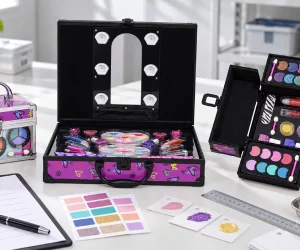
Pan layout should consider more than symmetry. Review finger and applicator access, spacing between colors, product visibility, insert walls, mirror clearance, hinge movement, and the path used to remove or replace an accessory. Decorative shapes may need extra space around corners or narrow sections.
Use a full-size drawing for an early review, then move to a physical sample. The assembled sample can reveal access problems and collisions that a flat rendering does not show.
Choose applicators as part of the architecture
An applicator occupies space and needs a defined retention method. Confirm its dimensions, handle, head, color, material reference, quantity, and position. Check whether the user can remove it without touching adjacent products and whether it remains in place when the palette is moved.
If the palette includes several product formats, define which applicator belongs to which product. Do not add a brush or puff after the insert dimensions are fixed.
Coordinate case, insert, and closure
The case, internal tray, hinge, latch, mirror, and decorative elements should be reviewed as one assembly. Confirm opening angle, closing clearance, insert retention, product height, and any contact between the lid and filled products. The intended packed configuration should also be considered when reviewing movement and protection.
The kids makeup packaging development guide explains stock components, custom molds, inserts, decoration, and artwork control.
Compare stock and custom structures
A stock palette can be differentiated through color, decoration, artwork, outer packaging, and product arrangement when the existing layout supports the concept. A custom mold can create a new silhouette, compartment system, or mechanism, but it introduces tooling, engineering, samples, approvals, and project-specific quantity considerations.
Before selecting a custom route, identify which requirement cannot be achieved with available components and whether that difference matters to the retail proposition.
Control artwork and theme assets
Record the printable area, dieline, decoration method, color references, file version, languages, barcode area, and required copy. If the buyer supplies characters, illustrations, or licensed assets, keep rights and approvals within the buyer’s documented process.
Avoid allowing artwork to hide product information or create a visual promise that the final contents do not match.
Approve the palette in stages
A practical sequence is:
- concept and full-size layout;
- case and insert structure;
- product and shade samples;
- filled pans or components;
- applicators and accessories;
- decorated case and artwork proof;
- complete assembled palette and outer packaging;
- approved reference and written specification.
Use the kids makeup sample approval checklist to record versions, open items, and the final reference before the agreed production gate.
Palette development brief
- retail role, destination market, and selling window;
- case size, shape, stock or custom route;
- product formats, shades, pans, and positions;
- applicators, mirror, accessories, and retention;
- insert, hinge, latch, and opening requirements;
- artwork, decoration, and market versions;
- estimated quantity and approval plan;
- required evidence and document checkpoints.
When the brief and layout are ready for review, contact AKIACO with the palette concept, product formats, shade count, packaging reference, destination market, and estimated quantity.
FAQ
Include the palette role, product formats, shade count, pan layout, applicators, case and closure, artwork, quantity, destination market, and approval plan.
Choose a shade count that supports the play concept, retail price and package size without making pans too small or the layout difficult to use.
A physical sample shows finger and applicator access, pan spacing, insert fit, product visibility, and how the complete palette opens and closes.
It can, but each format needs a defined position, component or pan, application plan, labeling scope, and sample reference.
Consider custom tooling when stock cases cannot provide the required silhouette, internal layout, mechanism, or brand distinction and the project can support the added development.