Peel-off nail polish for kids is a type of cosmetic coating that forms a flexible film on the nail surface. Unlike solvent-based polish, it is designed to lift off in one layer when gently pulled, rather than needing chemical removers.
At a basic level, it relies on water-based or low-solvent polymer systems that dry into a continuous film. According to general cosmetic formulation references (e.g., Cosmetic Ingredient Review reports), these systems reduce reliance on acetone-like solvents commonly used in adult products.
Why It Was Developed for Children
This type of polish was introduced as a response to concerns about solvent exposure and removal difficulty in traditional nail products. Children’s nails are thinner and more flexible, so harsh removers may be more irritating in some cases.
At the same time, standard nail polish removal often requires acetone or similar solvents. In pediatric cosmetic discussions (e.g., dermatology guidance summaries), reducing unnecessary solvent contact is often considered when designing child-focused products. Peel-off systems offer a simpler removal mechanism.
Key Differences from Adult Nail Polish
One major difference is the polymer structure. Adult nail polish usually uses stronger film-formers like nitrocellulose with solvent evaporation. Peel-off versions for kids often use softer acrylic or water-dispersed polymers that stay flexible after drying.
Another difference is adhesion strength. Adult polish is designed to last days or weeks and resist water and friction. Peel-off nail polish is engineered to have lower bonding energy, so it can separate from the nail surface without dissolving agents. This also means wear time is generally shorter and more variable.
How Peel-Off Nail Polish for Kids Works
Peel-off nail polish for kids works through a controlled drying process that turns liquid polish into a flexible surface film. Instead of bonding strongly with the nail, it creates a weak physical grip. This allows the layer to be removed in one piece under the right conditions.
The system is based on polymer science used in many cosmetic films. Once applied, water and volatile components evaporate, leaving behind a continuous coating. Its behavior depends on film strength, thickness, and how well it adapts to the nail surface.
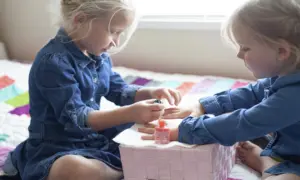
Film-Forming Technology Explained
Film-forming is the core mechanism behind peel-off nail polish for kids. Polymers in the formula align as the liquid dries, creating a thin but continuous layer. This layer is similar to a plastic-like skin, but much softer and more flexible.
In cosmetic chemistry, film formers are chosen based on their glass transition temperature (Tg), which affects how rigid or flexible the dried layer becomes. In kids’ versions, the Tg is often kept lower so the film does not become brittle. This makes peeling possible without cracking.
The final structure is not chemically bonded to the nail plate. Instead, it relies on surface contact and mild adhesion forces. That is why it behaves differently from long-wear nail polish.
Role of Water-Based Formulas
Many peel-off nail polishes for kids use water as the main solvent. Water carries dispersed polymers and pigments onto the nail surface. As it evaporates, the ingredients come closer together and form a stable layer.
Compared with solvent-heavy systems, water-based formulas tend to have milder odor and slower evaporation. However, they can also be more sensitive to humidity and application thickness. These factors influence how evenly the film forms.
The balance of water and polymer is important. Too much water can weaken the film, while too little may affect spreadability. Manufacturers adjust this ratio to achieve a usable texture for short wear cycles.
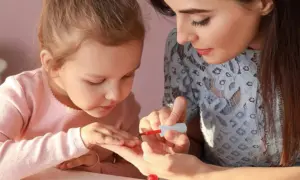
Why It Can Be Peeled Instead of Removed with Solvent
Peelability comes from low interfacial adhesion between the polish film and the nail surface. The formula is designed so that the bond strength stays weaker than the internal strength of the film itself. This allows it to lift as a sheet.
Instead of dissolving the coating like acetone-based removers do, mechanical force is enough to separate it. The film essentially detaches along the boundary layer between polish and keratin. This is why slow, gentle peeling works better than quick pulling.
Environmental conditions also matter. Water exposure, friction, and natural nail oils gradually reduce adhesion. Over time, these small changes make the film easier to lift without solvents.
Common Ingredients in Peel-Off Nail Polish for Kids
Peel-off nail polish for kids is built from a mix of simple cosmetic materials that work together to form a thin, flexible film. Most formulas avoid strong solvents and instead rely on water-based systems. The goal is controlled drying, mild adhesion, and easy removal without chemical removers.
From a formulation point of view, each ingredient has a specific role. Some form the film, some provide color, and others help stabilize texture. The overall structure is kept as simple as possible to support short wear cycles and easy peeling.
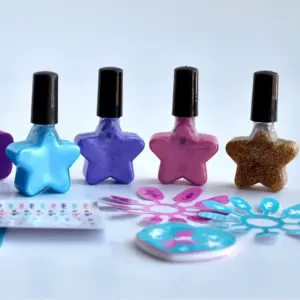
Water-Based Formulation Components
Water is often the main carrier in peel-off nail polish for kids. It helps distribute other ingredients evenly across the nail surface during application. As the water evaporates, the remaining materials begin to form a continuous film.
Along with water, water-soluble or water-dispersible polymers are commonly used. These polymers are responsible for film formation and flexibility. Examples in cosmetic chemistry include acrylate copolymers or polyvinyl-based materials, which are widely used in non-toxic cosmetic coatings (as described in general cosmetic ingredient safety reviews by CIR).
Plasticizers may also be included in small amounts. Their role is to reduce brittleness, so the dried layer does not crack easily. Without them, the film would be too rigid and harder to peel in one piece.
Pigments and Colorants Used in Kids’ Nail Polish
Color in peel-off nail polish comes from pigments and dyes that are approved for cosmetic use. These materials are finely ground so they spread evenly in the liquid base. Common types include iron oxides, titanium dioxide, and synthetic organic pigments used in regulated cosmetics.
The choice of pigment affects not only color but also opacity and drying behavior. For example, opaque pigments like titanium dioxide can make the coating thicker in appearance, while transparent dyes create lighter tones. The balance is adjusted so the film still forms properly.
Pigments must remain stable during drying. If they separate or clump, the film becomes uneven. That is why dispersing agents are often added to keep particles evenly spread throughout the formula.
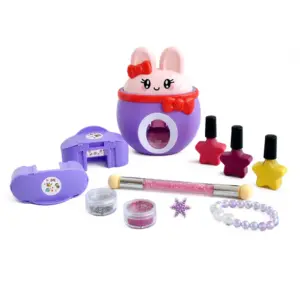
Safety Considerations of Cosmetic Ingredients
In children’s nail products, ingredient selection follows stricter limits compared to general cosmetics. Regulatory bodies such as the U.S. FDA and EU Cosmetic Regulation (EC No 1223/2009) provide guidelines on permitted colorants and restricted substances in cosmetic use.
One key focus is avoiding high levels of volatile organic solvents. Water-based systems help reduce exposure to strong odors and irritants. However, “water-based” does not automatically mean risk-free, so ingredient safety is still evaluated individually.
Another consideration is skin contact. Although nail polish is meant for nails, accidental contact with surrounding skin is expected. For this reason, ingredients are chosen to minimize known irritants, and concentrations are kept within cosmetic safety limits.
Safety Considerations of Peel-Off Nail Polish for Kids
Safety in peel-off nail polish for kids is mainly about controlled use and understanding how children’s skin and nails react to cosmetic films. While these products are designed to be milder than adult formulas, they are still chemical systems applied to a sensitive surface. Proper guidance helps reduce unnecessary irritation and misuse.
From a dermatological perspective, children’s nails and surrounding skin are thinner and more reactive. So even simple cosmetic layers can behave differently compared to adults. That is why usage conditions matter as much as the ingredients themselves.
Age Recommendations and Supervision Guidelines
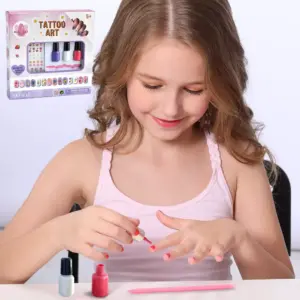
Most cosmetic guidelines treat children’s nail products as “supervised-use” items. This means an adult should apply or at least closely guide the process. The reason is not only safety, but also correct application and removal.
Younger children may try to peel the polish too early or pull it off aggressively. This can stress the nail surface mechanically. So supervision helps control timing and technique, keeping the process gentle and predictable.
Age recommendations vary by region and product formulation, but in general, very young children (especially under preschool age) are more likely to need full adult application. Older children can often participate, but still benefit from oversight.
Allergy Awareness and Patch Testing
Even mild cosmetic products can occasionally cause sensitivity reactions. These are usually not caused by a single ingredient alone, but by how the skin responds to a combination of materials such as polymers, pigments, or additives.
Patch testing is a simple way to reduce uncertainty. A small amount of product is applied to a limited skin area and observed over time for redness, itching, or irritation. This is a common precaution in dermatology practice when introducing new topical products.
It is also important to note that reactions may not appear immediately. Some sensitivities develop after repeated exposure. So observation over multiple uses is more informative than a single test.
Nail and Skin Sensitivity in Children
Children’s nails are still developing and tend to be thinner than adult nails. This makes them more flexible but also more prone to surface disruption if exposed to repeated peeling or friction. The nail plate is composed of keratin layers that can lift slightly under mechanical stress.
The skin around the nails, called the periungual area, is also more sensitive. If polish is pulled off too quickly, it can affect this surrounding tissue. That is why gentle removal techniques are preferred over forceful peeling.
In some cases, overuse of peel-off products may temporarily roughen the nail surface. This is usually mild and reversible, but it highlights the importance of allowing rest periods between applications.
Benefits of Peel-Off Nail Polish for Kids
Peel-off nail polish for kids is designed as a simplified cosmetic system that focuses on short wear and easy removal. Its main advantages are linked to its physical structure rather than long-lasting performance. In practical use, it reduces steps needed for removal and avoids the need for strong chemical solvents.
From a formulation perspective, the benefits come from lower adhesion strength and flexible film behavior. These properties make it suitable for short creative use, especially in supervised environments like home activities or events.
Easy and Non-Messy Removal
One of the main features of peel-off nail polish is its removal method. Instead of using liquid removers, the dried film can be lifted from the nail surface in one piece. This process is based on mechanical separation rather than chemical dissolution.
In practice, removal is usually done by gently lifting an edge of the film and peeling it away slowly. When applied correctly, it reduces liquid spills and cotton pad use. However, the ease of removal still depends on application thickness and how long the polish has been worn.
Environmental factors also play a role. For example, after hand washing or exposure to water, the adhesion may weaken slightly. This makes the film easier to lift without extra tools.
Reduced Exposure to Harsh Removers
Traditional nail polish removal often relies on solvents such as acetone or ethyl acetate. These compounds are effective at breaking down strong polymer bonds, but they can also be drying to skin and nails with repeated use.
Peel-off systems avoid this step entirely. Since the film is not chemically dissolved, there is no need for solvent-based removal. This reduces direct contact with strong volatile substances during routine use.
It is still important to note that “reduced exposure” does not mean “no exposure to chemicals.” The polish itself is still a formulated cosmetic product, and safe handling practices remain relevant. But the removal stage is simplified from a chemical perspective.
Encouraging Creative Expression Safely
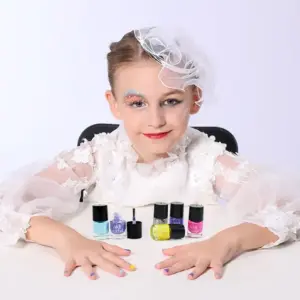
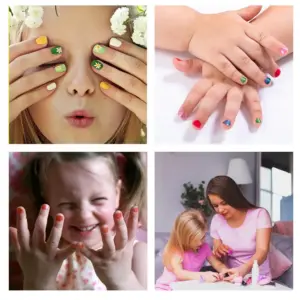
From a developmental point of view, peel-off nail polish can be used as a controlled medium for color play. It allows children to explore patterns and colors without a long commitment to wear time. This short cycle can make experimentation easier to manage.
Because the product is temporary, mistakes are less permanent. This can reduce frustration during application and encourage repetition and learning. In structured settings, it also allows for quick change between designs.
However, safe use still depends on boundaries. Application should be guided, and nails should not be peeled repeatedly in a short period. Within those limits, it serves as a low-barrier tool for basic cosmetic creativity.
Potential Risks of Peel-Off Nail Polish for Kids
Peel-off nail polish for kids is generally designed for short and gentle use, but it still interacts with a living surface: the nail plate. Because of this, certain risks can appear, especially when it is used too often or removed incorrectly. Most concerns are related to mechanical stress rather than chemical exposure.
From a practical safety standpoint, the key issue is balance. The same feature that makes it easy to remove can also lead to problems if peeling becomes too frequent or too forceful.
Nail Weakness from Frequent Peeling
The nail plate is made of layered keratin cells. When peel-off polish is removed, it separates along weak adhesion points between the film and the nail surface. If this process is repeated too often, it may gradually affect the outer keratin layers.
In some cases, nails can feel slightly rough or appear less smooth after repeated peeling. This is usually not permanent, but it reflects mild surface disruption. Dermatology references often describe this as superficial nail plate stress caused by repeated mechanical lifting.
The risk increases when the polish is peeled off before it has fully loosened on its own. Premature removal requires more force, which can pull at the upper nail layers.
Choking or Ingestion Concerns in Younger Children
For younger children, one practical concern is accidental ingestion. Small peeled pieces of dried polish can be tempting to touch or play with, especially because they form flexible strips or flakes after removal.
While most cosmetic polymers used in nail products are not designed for ingestion, the main risk here is physical, not chemical. Small fragments could pose a choking hazard if placed in the mouth.
Because of this, supervision is important during both application and removal. Clean-up of peeled pieces should be done immediately, and children should be guided not to handle or chew the material.
Overuse and Nail Surface Stress
Overuse refers to applying and removing peel-off polish in very short cycles without allowing the nail to rest. This can increase repeated stress on the same surface area of the nail plate.
When polish is applied too frequently, the nail surface may experience alternating bonding and peeling forces. Over time, this can lead to mild surface irregularities, such as temporary dullness or slight flaking at the edges.
The effect is usually reversible once usage is reduced. Allowing rest periods between applications helps the nail’s natural keratin structure recover. In simple terms, the nail behaves better when it is not constantly being coated and peeled.
How to Apply Peel-Off Nail Polish for Kids Properly
Application is a key part of how peel-off nail polish behaves after drying. Even though the formula is designed to be simple, the way it is applied can change how smooth the film becomes and how easily it later peels off. A controlled, light application usually gives the most stable result.
From a practical standpoint, the process is less about precision art and more about consistency. Thin, even layers help the polymer film form correctly as it dries.
Preparing the Nails Before Application
Before applying peel-off nail polish, the nail surface should be clean and dry. Natural oils, dust, or leftover products can interfere with how the film anchors to the nail plate. A gentle wash with mild soap and water is usually enough.
After washing, nails should be fully dried. Moisture trapped on the surface can weaken adhesion and cause uneven drying. In some cases, lightly pushing back the cuticle area can help create a clearer application zone, but this should be done gently without force.
It is also best to avoid applying lotion or oily products right before polishing, since these can create a slippery layer that affects bonding.
Applying Thin and Even Layers
Peel-off nail polish works best when applied in thin coats. A single thick layer may trap moisture inside, which slows drying and can weaken the final film structure. Thin layers allow water to evaporate evenly and support proper film formation.
The brush should be loaded lightly, and the polish spread in smooth strokes. Uneven buildup at the edges can create weak points where peeling may start too early or in fragments instead of a clean sheet.
If a second layer is needed, it should only be applied after the first layer is fully dry. This helps maintain a stable base for the final film.
Drying Time and Common Application Mistakes
Drying time depends on formula type, layer thickness, and room conditions. Water-based systems generally dry through evaporation, so airflow and humidity matter. A slightly longer wait is often needed compared to solvent-based polish.
A common mistake is touching the surface too early. Even if the top feels dry, the inner layer may still be soft. Premature contact can create dents or weak spots in the film structure.
Another frequent issue is applying too many layers. While it may look more opaque, extra thickness can reduce flexibility and make peeling uneven. Allowing each layer to fully dry before adding another helps maintain a consistent film.
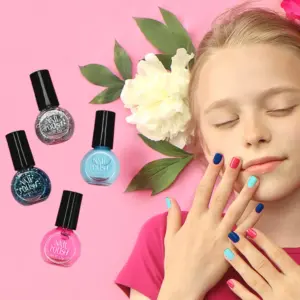
Nail Care Tips While Using Peel-Off Nail Polish for Kids
Nail care during the use of peel-off nail polish for kids is mostly about maintaining balance between decoration and natural recovery. Although the polish is designed for easy removal, the nail plate still goes through repeated cycles of covering and peeling. Simple care habits help keep the nail surface stable over time.
From a basic biological view, nails are made of keratin layers that slowly grow and renew. Any cosmetic layer placed on top should allow this natural process to continue without constant disruption.
Keeping Nails Hydrated and Healthy
Nails themselves do not “drink” moisture, but the surrounding nail plate and cuticle area respond to hydration levels. When the skin around nails becomes dry, the edges of the nail plate can also appear rough or uneven.
Using mild hand care after polish removal can help restore surface comfort. For example, washing hands gently and avoiding harsh soaps reduces unnecessary dryness. In some cases, light moisturizing around the cuticle area helps maintain flexibility of the surrounding skin.
It is also important to avoid applying polish on damaged or visibly irritated nail surfaces. A stable base supports more even film formation and reduces uneven peeling later.
Allowing Nail Rest Periods
Even though peel-off nail polish is temporary, repeated application without breaks can create continuous surface stress. The nail plate benefits from short periods without any coating, allowing it to remain in its natural state.
During rest periods, the nail continues its normal growth cycle without external film layers. This helps reduce buildup of minor surface irregularities that can occur after repeated peeling cycles.
A simple practical approach is to alternate between use and non-use days or weeks, depending on frequency. This avoids constant mechanical interaction with the same nail surface.
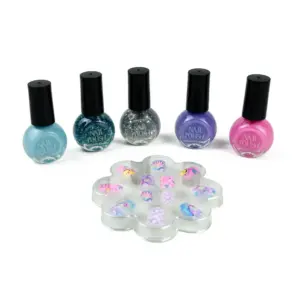
Monitoring Nail Growth and Condition
Observing nail condition over time is a practical part of safe cosmetic use. Nails grow slowly, so changes are usually gradual rather than sudden. Looking at the surface texture, smoothness, and edge condition can help identify whether the nail is reacting well to repeated polish use.
If the nail begins to show persistent roughness or splitting at the edges, it may indicate that the surface is under repeated mechanical stress. In such cases, reducing usage frequency is a reasonable adjustment.
Growth patterns can also be informative. Healthy nails generally grow forward with a smooth surface transition from cuticle to tip. Regular observation helps ensure that cosmetic use remains secondary to natural nail health.
Conclusion
Peel-off nail polish for kids is built around simple material science and gentle removal, but it still interacts with a sensitive surface. Understanding how it forms, applies, and peels helps set realistic expectations for use. When applied in thin layers and removed with care, it can fit into short, supervised routines. Still, nail rest periods and basic hygiene remain important to keep the nail plate stable over time.